
“…a fleet of sail-spanned Bagalas be seen approaching the harbor, either at Galle or at Colombo, and our interest and curiosity are unlimited. Speculation about the Maldive Islands and the Maldivians is renewed once again when the Bagalas have anchored in the harbor; they symbolize for us all that is legendary and of fairyland.
The men then come ashore, some carrying strings of Bondi Haluva… As they walk along our streets talking in a language compounded of Sinhalese words… they kindle feelings like those towards long-lost kinsmen.”
In 1949, Sri Lankan writer Jinadasa Wijayatunga wrote, describing Maldivians as “island neighbors.”
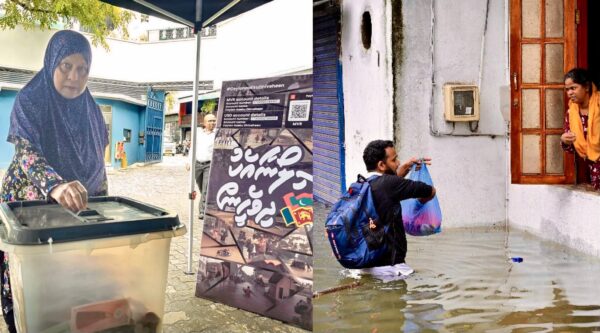
When countless people were in distress during the cyclone ‘Ditwah’ that ravaged neighboring Sri Lanka, heartfelt appreciation poured in for the support extended by the Maldivians. The tiny nation, despite its small population, offered more assistance than many of the world’s wealthiest and biggest countries. In return, Sri Lankans expressed their thanks and showed heartfelt affection to the Maldives.
“Although it is a small island, the Maldives is a country with a heart bigger than the ocean,” wrote a Sri Lankan expressing gratitude to Maldivians.
The relationship between the Maldives and Sri Lanka is thousands of years old—a bond of culture, ancestry, and language. In 4th century CE, Divis (Maldivians) and Sarendivis (the people of Sarandīb, or Ceylon) are recorded to have travelled together to the court of Roman Emperor Julian. For thousands of years, Maldives and Sri Lanka have had strong trade and cultural ties while also facing climatic hardships.
Fernão De Queyroz, who wrote the history of Ceylon during the Portuguese period, mentioned an interesting story that when some Maldivian islands were submerged (during a storm or in a climate crisis), a group of Maldivians migrated to Sri Lanka. This was over 300 years ago. The Maldivians migrated to coastal towns near Colombo, Alutgama, and Kalutara; the Maldivians called the area ‘Kalhuthuraa. A significant population of migrants from the Maldives lived in these two areas. Even now, the Muslim population of Sri Lanka is large in these two areas.
The Sri Lankan people would have supported Maldivians who migrated there in times of distress, just as there must have been many moments throughout history when Maldivians helped the people of Sri Lanka. The historical relationship between the two nations is built on mutual compassion and shared resilience.
Maldivians have long embodied a natural spirit of helpfulness. Known for their compassion and sincere care for visitors, they aided ships crossing the Indian Ocean that stopped in the islands. Regardless of race and religion, Maldivians helped those in need—aiding distressed vessels, offering fresh water to departing ships, and sharing whatever they had at hand. This enduring tradition reflects the deeply rooted generosity of Maldivian culture.
C.W. Rosset of Germany, who visited the Maldives in 1886 and captured the first known photographs of Maldivians, wrote,
“… the people are friendly and as far as their poverty allows them, they are extremely hospitable.”
H.C.P. Bell, who served as the Commissioner of Archaeology during the British period in Ceylon, said;
“Maldivians are a civilized and peaceful race of people.”
Maldivian civilization is not defined by large structures or towering buildings. It is defined by the compassion shown to guests, the willingness to help others, and the noble qualities and skills that have shaped the Maldivian way of life.
In 1834, two British surveyors, Young and Christopher, visited the Maldives. They found the people quiet, peaceable, and hospitable and kind to strangers, though distrustful of them, affectionate, tending the sick and esteeming humanity and charity.
Maldivian hospitality and helpfulness form the foundation of the nation’s largest industry: tourism. The resort tourism industry and local tourism are built upon Maldivian hospitality. The natural beauty of the Maldives and its hospitality now drive a global industry, the spirit behind them is thousands of years old.
__________________________
References
- Island Story, Jinadasa Vijyatunga, 1949
- The Temporal and Spiritual Conquest of Ceylon, Fernão De Queyroz, 1687
- The Maldives Islands: Monograph on the History, Archaelogy, and Epigraphy, 1940
- People of the Maldive Islands, Clarence Maloney, 1980